All-on-4 Dental Implants in Washington, DC
A full arch of permanent, natural-looking teeth — often in a single visit
Please don't hesitate to call us at (202) 920-1410
All-on-4 dental implants replace an entire upper or lower arch of teeth using just four strategically placed titanium implants — restoring full chewing power, facial structure, and confidence in a way that traditional dentures simply can't match.
At Georgetown Advanced Dentistry, Dr. Sinclair Davis, DDS, plans and performs All-on-4 cases in-house — leveraging his Johns Hopkins Oral Surgery Fellowship and CAD/CAM restorative technology to deliver comprehensive full-arch results without shuttling patients between multiple offices. If you've been living with failing teeth, loose dentures, or the daily impact of missing teeth, All-on-4 offers a permanent solution that looks, feels, and functions like your own teeth. We serve patients throughout Washington, DC, including Georgetown, Palisades, Chevy Chase, Tenleytown, and Northwest DC.
Four Implants. One Full Arch. Permanent Results.
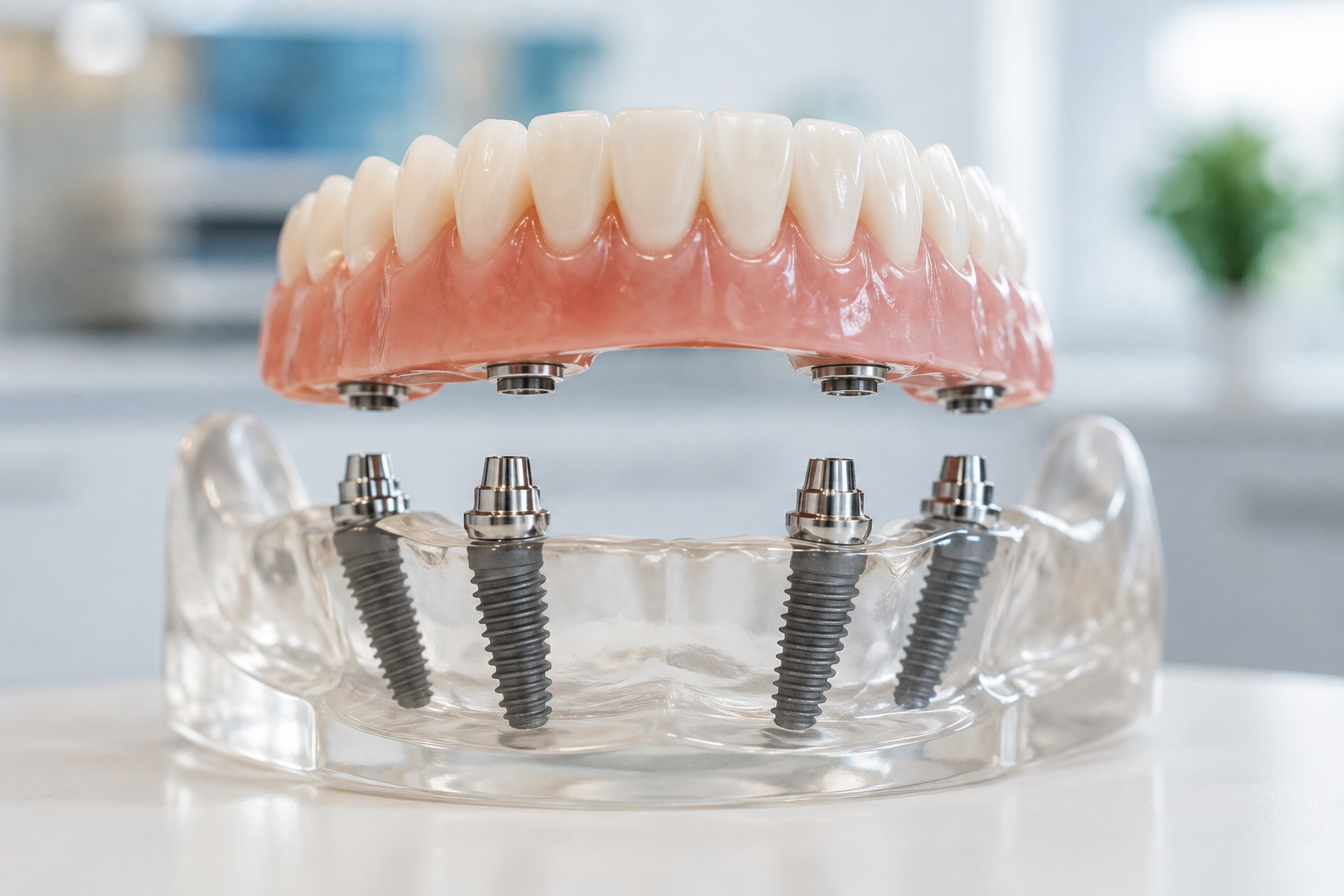
All-on-4 uses a smart engineering approach: instead of one implant per missing tooth, four strategically angled titanium posts anchor a full-arch prosthetic bridge. The back implants are tilted to make maximum use of your existing jawbone density — which is why most patients avoid the need for bone grafting.
- Permanent & Fixed The bridge stays in place 24/7 — brushed like natural teeth, never removed.
- Same-Day Teeth in Most Cases Many patients leave surgery with a temporary, functional set of teeth the same day.
- Full Bite Force Restored Eat crunchy and tough foods that slip-prone dentures make impossible.
- Preserves Jawbone Titanium posts stimulate bone growth, preventing the facial collapse linked to tooth loss.
The Pros and Cons of All-on-4
All-on-4 is a transformative option for the right patient — but no procedure is right for everyone. Here's the honest picture.
The Pros
- Permanent, fixed teeth that never come out
- Look, feel, and function like natural teeth
- Same-day teeth in most cases
- Full bite force restored — eat what you want
- Prevents jawbone loss and facial collapse
- No slipping, no adhesives, no clicking
- Long-term value: titanium can last decades
The Considerations
- Higher upfront investment than traditional dentures
- Requires oral surgery and a healing period
- Several months of soft-food diet during integration
- Demands diligent daily hygiene (water flosser needed)
- Not ideal for uncontrolled medical conditions
- Speech adjustment period during first few weeks
- Prosthetic bridge may need service after 10–15 years
All-on-4 vs. Traditional Dentures
Both options replace missing teeth — but the day-to-day reality and long-term health outcomes are meaningfully different.
All-on-4 Implants
Permanent · Fixed · Feels Natural
Traditional Dentures
Removable · Lower Upfront Cost
Who's an Ideal Candidate?
All-on-4 is life-changing for the right patients — and not the right fit for everyone. Dr. Davis evaluates every case honestly during consultation.
Ideal Candidates
- Missing most or all of their teeth in one or both arches
- Tired of loose or uncomfortable removable dentures
- Want a permanent, fixed solution that stays in place
- Have adequate bone volume — or can be grafted first
- In good overall health and can undergo minor surgery
- Committed to diligent daily oral hygiene
- Non-smokers or willing to quit for optimal healing
May Not Be Ideal If
- Uncontrolled diabetes or other medical conditions
- Heavy smokers unwilling to quit before surgery
- Untreated gum disease requiring stabilization first
- Insufficient jawbone without willingness for grafting
- Medical conditions that prevent surgical procedures
- Cannot commit to the required daily hygiene routine
Your Path from Consultation to Final Prosthetic
All-on-4 treatment happens in phases — with careful planning up front, precise surgical work, and a healing period before the final permanent teeth are placed.
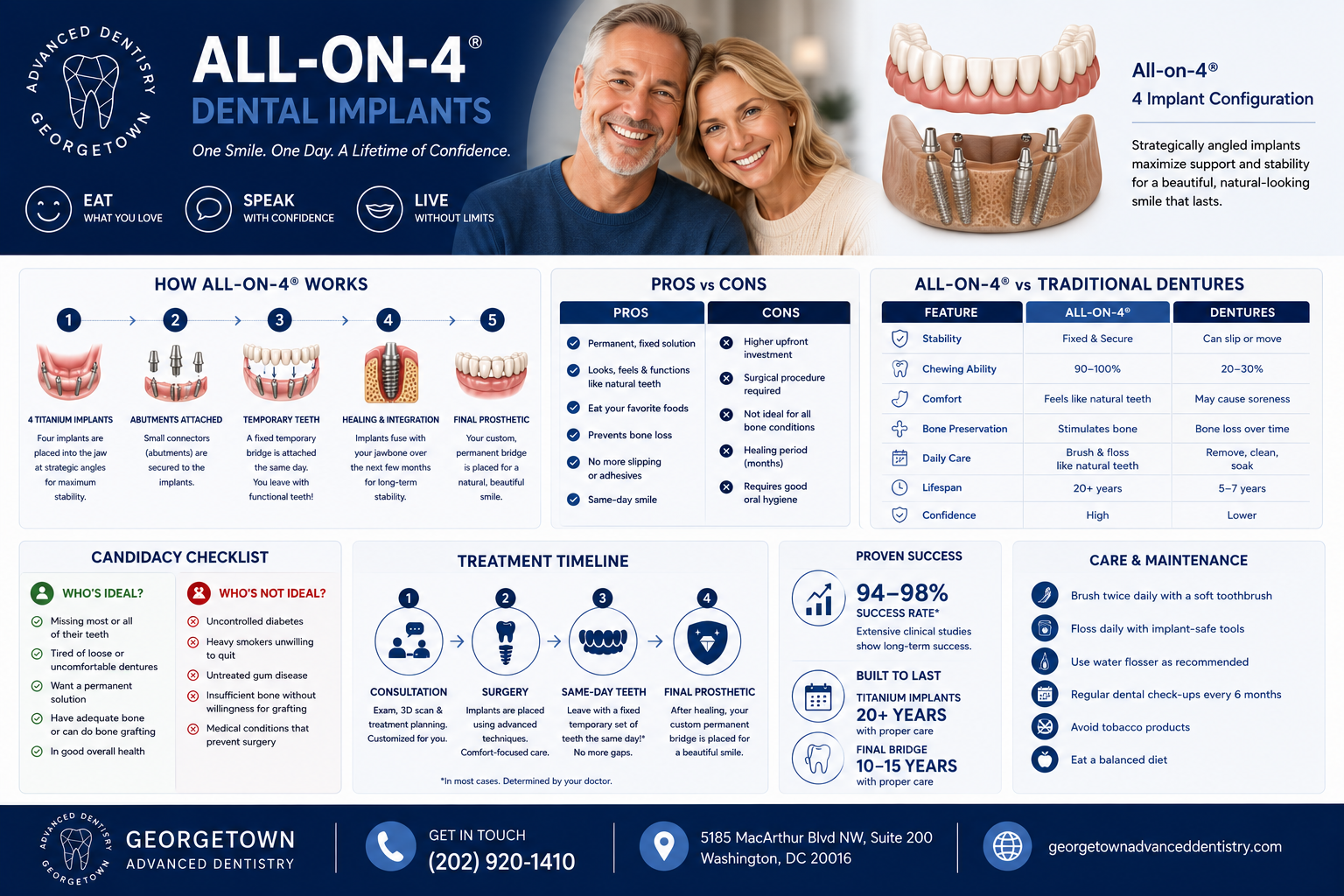
Consultation, 3D Scan & Treatment Planning
Complete oral exam, digital 3D imaging of your jaw and remaining teeth, medical history review, and detailed treatment mapping. Dr. Davis identifies the ideal implant positions and confirms candidacy. Together we outline exactly what your treatment will involve.
Implant Placement & Same-Day Temporary Teeth
Any remaining failing teeth are removed, four titanium implants are precisely placed at strategic angles, and a fixed temporary bridge is attached the same day. You'll leave with functional teeth — no time spent without a smile. Comprehensive sedation options ensure comfort throughout.
Healing & Osseointegration
The titanium implants gradually fuse with your jawbone — a biological process called osseointegration that creates the permanent foundation for your final teeth. You'll follow a soft-food diet during this phase and attend periodic check-ins to monitor healing progress.
Final Prosthetic Placement
Your custom-designed permanent bridge — engineered for a beautiful, natural appearance and full chewing function — is attached to the fully integrated implants. Bite adjustments, final photography, and long-term care planning complete the treatment.
A Long-Term Investment in Your Health & Quality of Life
All-on-4 represents a significant financial commitment, but for the right patient, the value measured across decades — restored function, preserved facial structure, and daily confidence — far exceeds the cost of decades of denture relines, replacements, and adhesives. Because every case is unique, precise pricing requires a personalized evaluation. Financing through CareCredit, HSA/FSA pre-tax funds, and phased treatment options are all available. We'll walk through everything at your consultation.
Frequently Asked Questions
Straight answers to what patients ask most about All-on-4 dental implants.
What is the failure rate of All-on-4 dental implants?
All-on-4 dental implants have a remarkably high success rate — typically between 94% and 98%. Failures are uncommon and usually occur during the initial healing (osseointegration) phase or later due to chronic issues. The primary risk factors that increase failure rates include uncontrolled systemic conditions like diabetes, heavy smoking, poor oral hygiene leading to peri-implantitis, and severe teeth grinding without a protective night guard. Dr. Davis screens for these factors during consultation to maximize your long-term outcome.
What's better than All-on-4 implants?
All-on-4 is considered the gold standard for full-arch restoration for most patients — but alternatives may suit specific clinical needs. All-on-6 or All-on-8 uses more implants for patients with heavy bite forces or exceptional bone density. Traditional individual implants replacing every missing tooth provide the most independent, natural feel but require massive bone volume and multiple surgeries at significantly higher cost. Removable implant overdentures snap onto 2–4 implants for improved stability compared to traditional dentures, but can still be taken out at night.
What can go wrong with All-on-4 dental implants?
Potential complications, though uncommon, include implant failure (roughly 5% of cases — when titanium posts don't properly fuse with bone due to poor bone quality, smoking, or medical conditions); peri-implantitis (chronic gum inflammation from inadequate hygiene); mechanical damage such as chipping or wear of the prosthetic teeth; and rare surgical complications like nerve irritation or sinus issues for upper-jaw implants. Careful patient selection, proper technique, and diligent hygiene minimize all of these risks significantly.
What should I expect 2 months after getting All-on-4 dental implants?
At the 2-month mark, you're typically deep into the osseointegration healing phase where your jawbone is actively fusing around the titanium posts. Initial surgical swelling and tenderness will have fully resolved by then. You'll still need to follow a soft-to-medium food diet to protect the healing implants from premature pressure. Dr. Davis will monitor your progress with periodic check-ins to confirm the implants are integrating properly and to prepare for the eventual placement of your final permanent prosthesis.
Is it hard to eat with All-on-4 implants?
Initially yes — but only during the healing phase. Right after surgery, you must stick to a strict soft-food diet for several months to protect the implants while they fuse with the bone. Once healing is complete and your final permanent bridge is placed, eating becomes remarkably easy and natural. Unlike traditional dentures that limit your diet, All-on-4 restores near-full bite force, allowing you to comfortably chew crunchy, tough, and fibrous foods again — including apples, steak, corn on the cob, and other foods denture wearers typically avoid.
How long do All-on-4 implants last?
The titanium implant posts themselves can last 20 years to a lifetime once successfully integrated with the jawbone — they're structurally permanent components. However, the attached prosthetic bridge experiences daily mechanical wear and typically requires repair, refurbishment, or full replacement every 10 to 15 years depending on the material used (acrylic wears faster than zirconia). Consistent daily hygiene, avoiding tobacco, wearing a night guard for bruxism, and routine six-month check-ups all directly extend longevity.
Schedule an All-on-4 Consultation in Washington, DC
If you're ready to replace missing or failing teeth with a permanent, natural-looking solution, Dr. Davis can walk you through your options and outline the exact treatment plan that fits your goals. Contact Georgetown Advanced Dentistry to schedule your consultation.