Dental Implants in Washington, DC
Permanent tooth replacement built on surgical precision
Please don't hesitate to call us at (202) 920-1410
Losing a tooth changes more than your smile. It changes the way you bite, the way you speak, and — over time — the structure of your jaw.
Dental implants are the only tooth replacement option that addresses all of it: replacing not just the visible crown, but the root beneath it that keeps your jawbone healthy and your surrounding teeth stable.
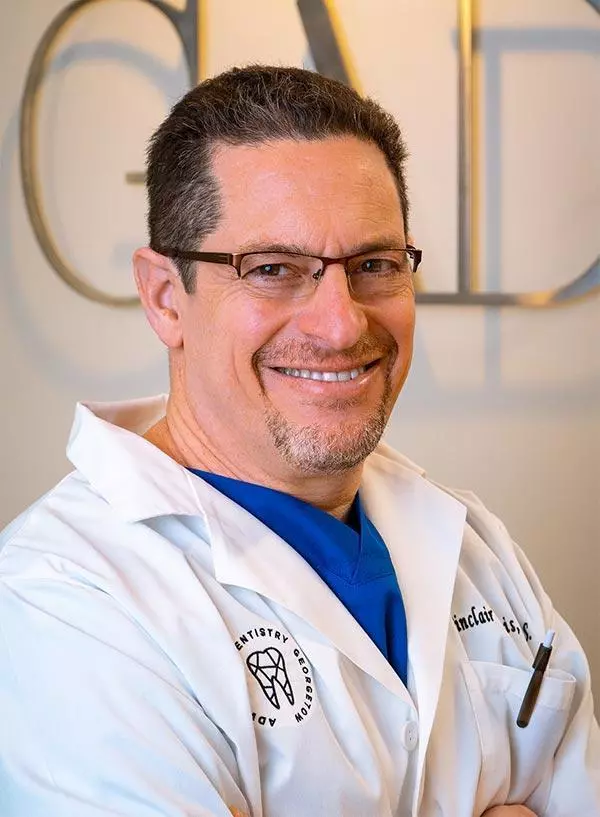
At Georgetown Advanced Dentistry, Dr. Sinclair Davis, DDS, brings surgical fellowship training from Johns Hopkins Hospital to every implant procedure. From single-tooth placements to full-arch reconstruction, each treatment plan is built around the individual anatomy of your jaw — not a one-size-fits-all protocol. We serve patients throughout Washington, DC, including Georgetown, Chevy Chase, Tenleytown, American University Park, Friendship Heights, and Northwest DC.
What Makes Dental Implants Different
A dental implant does what no other tooth replacement can: it replaces the root, not just the crown.
Traditional Tooth Replacement
Bridges, partials, and conventional dentures rest on the gums or depend on neighboring teeth for support.
- Rely on adjacent teeth as anchors
- Do not stimulate the jawbone
- Allow gradual bone loss over time
- May require replacement every 5–10 years
Dental Implants
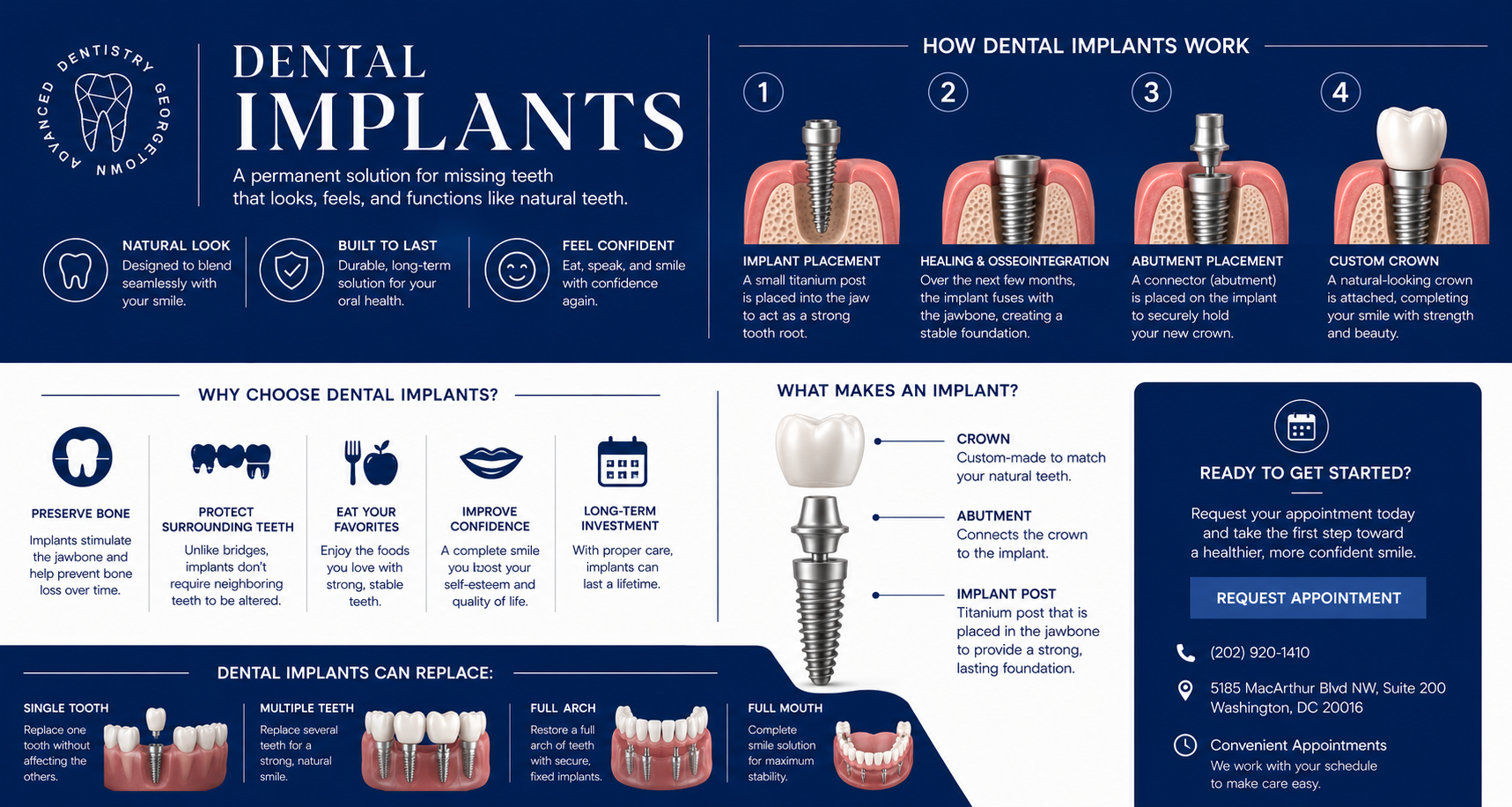
A titanium post fuses with the jawbone through osseointegration — acting as a permanent artificial root.
- Stand independently — no reliance on other teeth
- Stimulate and preserve jawbone density
- Function like natural teeth for eating and speaking
- Can last a lifetime with proper care
The Implant Process at Georgetown Advanced Dentistry
A five-step surgical and restorative pathway — sequenced around your individual anatomy and healing timeline.
Initial Evaluation
Every implant case begins with a thorough evaluation of your jawbone density, overall health, and treatment goals. Dr. Davis reviews your imaging to determine whether your jaw can support an implant directly, or whether a preparatory procedure — such as a bone graft or sinus lift — is needed first.
Bone Grafting When Needed
If bone loss has occurred after a tooth was removed — or if the bone was never dense enough to support an implant — bone grafting rebuilds that foundation before implant placement. Dr. Davis performs bone grafting in-office, often allowing the graft and implant to be sequenced efficiently without separate surgical teams or facilities.
Sinus Lift for Upper Jaw Implants
Implants in the upper back jaw require adequate bone below the sinus cavity. When that space is limited, a sinus lift elevates the sinus floor and places bone material beneath it — a technically demanding procedure Dr. Davis performs routinely as part of his oral surgery background.
Implant Placement
Once the jaw is ready, Dr. Davis places the titanium implant through a precise surgical incision, positioned to align with your natural bite and neighboring teeth. The healing phase typically spans three to six months, during which the implant fuses with the surrounding bone.
Restoration
After osseointegration is complete, an abutment is attached and a custom crown, bridge, or prosthetic is fabricated to match your natural teeth in color, shape, and proportion. Georgetown Advanced Dentistry uses CAD/CAM 3D design technology to create restorations with exceptional precision and fit.
Who Is a Good Candidate for Dental Implants?
Most healthy adults who are missing one or more teeth are candidates for implants. The key factors are sufficient jawbone density and healthy gum tissue. Conditions like controlled diabetes or osteoporosis require individual evaluation — they do not automatically disqualify a patient, but they shape the treatment approach. Patients with insufficient bone are often excellent candidates after bone grafting.
If you're preparing for a tooth extraction, the best time to plan for an implant is before the tooth is removed — that way, the site can be preserved and the timeline optimized.
Frequently Asked Questions
Straight answers to the questions patients ask most about dental implants.
How painful is getting one dental implant?
Most patients report that implant surgery is more comfortable than they expected. The surgical site is fully anesthetized during the procedure, and post-operative discomfort is typically manageable with over-the-counter pain medication for a few days.
What is the number one cause of dental implant failure?
Peri-implantitis — an infection of the tissue around the implant — is the leading cause of implant failure after placement. It is largely preventable with good oral hygiene and regular professional cleanings. Smoking and uncontrolled diabetes are the most significant risk factors.
What happens after 20 years of dental implants?
Well-maintained implants can last decades — many last a lifetime. The titanium post itself rarely fails; it is the crown or prosthetic on top that may eventually need replacement due to normal wear. Long-term success depends on oral hygiene, regular dental visits, and avoiding habits like grinding.
What happens if your body rejects a dental implant?
True implant rejection is rare. More commonly, early implant failure is caused by infection or insufficient bone integration. When failure does occur, it is typically identified early — the implant can be removed, the site allowed to heal, and the process attempted again with additional preparation.
Can you have dental implants if you have osteopenia?
Osteopenia does not automatically disqualify someone from implants. It requires a careful evaluation of bone quality at the implant site and may influence the timing and approach of the procedure. Dr. Davis reviews bone density findings as part of every implant consultation.
What is the downside to dental implants?
The most significant drawback is time. The full process — placement through osseointegration to final restoration — typically spans six to eight months. Preparatory procedures like bone grafting add to that timeline. For patients who need a faster solution, options can sometimes be sequenced more efficiently; that is a conversation best had during your consultation.
Schedule a Dental Implant Consultation in Washington, DC
If you are missing a tooth or anticipating an extraction, the best time to discuss implants is before the gap has time to affect your surrounding bone and teeth. Contact Georgetown Advanced Dentistry to schedule a consultation with Dr. Davis.