
Root Canals in Washington, DC
The procedure designed to relieve pain — not cause it — and save your natural tooth
Please don't hesitate to call us at (202) 920-1410
Of all the procedures in dentistry, root canal therapy may be the most misunderstood. Patients associate it with significant pain — when in reality, the procedure is designed to relieve pain, not cause it.
A root canal removes the infected or dying tissue inside a tooth, eliminates the source of the problem, and preserves a tooth that would otherwise need to be extracted. At Georgetown Advanced Dentistry, Dr. Sinclair Davis, DDS, performs root canal therapy with the precision and care that comes from advanced endodontic training and an oral surgery fellowship background from Johns Hopkins Hospital. For patients in Palisades, Georgetown, Glover Park, Friendship Heights, and surrounding Northwest DC neighborhoods, that level of clinical depth is available close to home.
What Is a Root Canal?
Every tooth is built in layers. Understanding what's inside helps explain why the procedure works — and why saving the tooth matters.
Enamel
The hard, protective outer surface of the tooth — the strongest substance in the human body.
Dentin
The softer, sensitive layer beneath the enamel that surrounds and protects the pulp chamber.
Pulp
The soft inner tissue containing nerves, blood vessels, and connective tissue — where infection begins.
Signs You May Need a Root Canal
Not every tooth that needs a root canal announces itself with obvious pain — but when symptoms are present, they typically follow this pattern.
Persistent Throbbing Toothache
A deep, persistent pain that often worsens when you lie down. Unlike the sharp, temporary sensitivity of a small cavity, this pain doesn't fade — it builds. It's the single most common signal that the pulp has been compromised beyond recovery.
Prolonged Temperature Sensitivity
Sensitivity to heat or cold that lingers long after the stimulus is removed — often for many seconds or minutes.
Pain When Biting
Sharp discomfort when biting down or applying pressure to the affected tooth.
Gum Swelling or Bumps
Tenderness, swelling, or a small pimple-like bump on the gum near the affected tooth.
Darkening or Graying
Discoloration of a specific tooth — often indicating that the nerve tissue inside has died.
When Is a Root Canal Necessary?
The clinical term is irreversible pulpitis — inflammation and infection of the pulp that has progressed beyond recovery. Common causes include:
Deep Decay
Cavities that have penetrated through the enamel and dentin into the pulp chamber.
Cracked or Fractured Tooth
A tooth crack that has allowed bacteria to reach the interior pulp.
Repeated Dental Procedures
Multiple treatments on the same tooth that have progressively stressed the pulp.
Physical Trauma
Impact injury to a tooth — even without visible damage — that has killed the nerve.
Dental Abscess
A pocket of infection at the root tip that has spread into the surrounding bone.
Asymptomatic Infection
Infected teeth that produce no symptoms but are identified on X-ray during a routine exam.
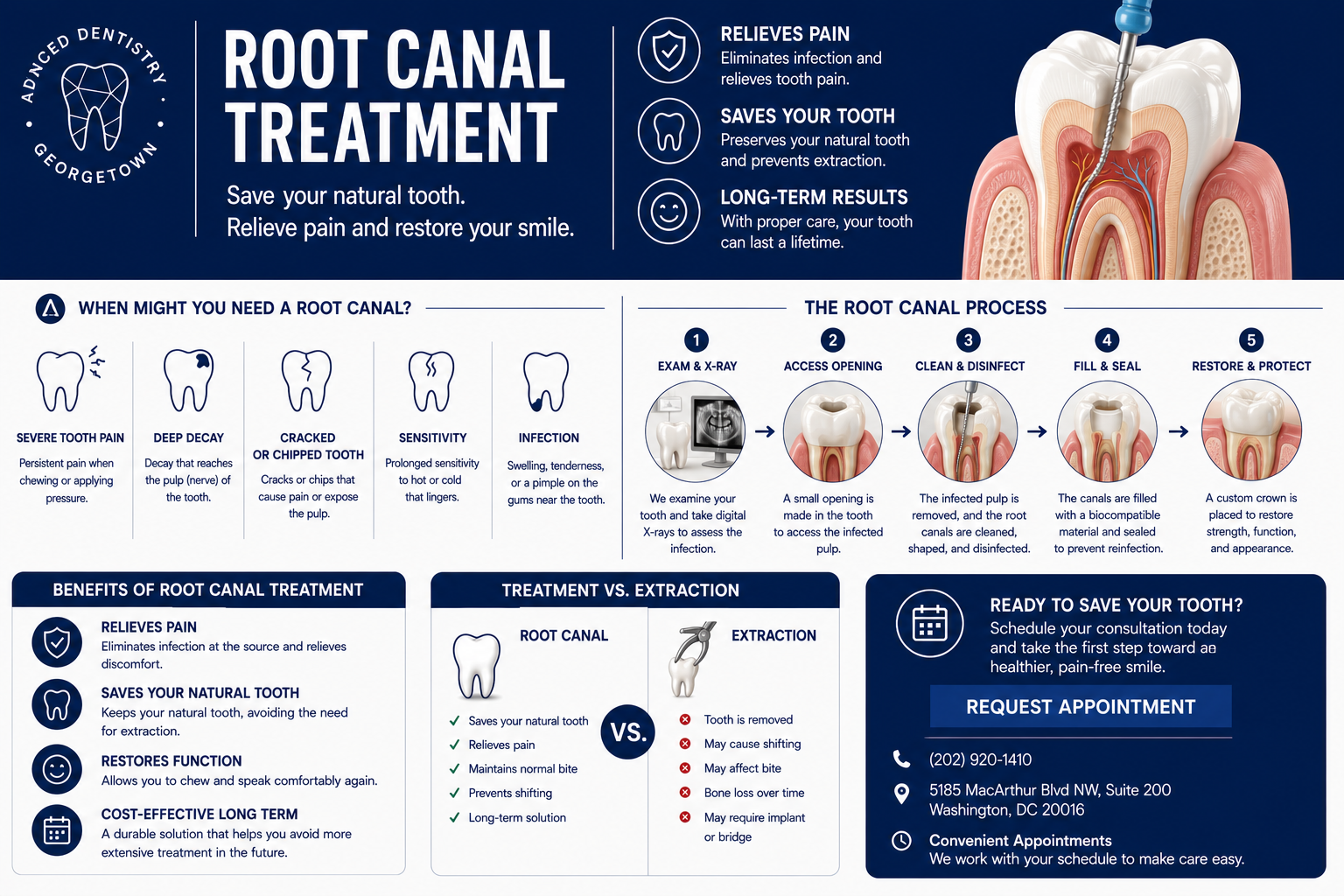
The Root Canal Process at Georgetown Advanced Dentistry
A five-step protocol built around precision, comfort, and long-term tooth preservation.
Diagnosis and Imaging
Dr. Davis conducts a thorough clinical examination and reviews digital X-rays of the affected tooth and surrounding bone. Imaging confirms the presence and extent of infection, the anatomy of the root canals, and any bone loss around the root tip.
Anesthesia and Comfort
The tooth and surrounding tissue are fully numbed with local anesthesia before the procedure begins. Modern anesthetics make root canal therapy no more uncomfortable than getting a standard filling — patients typically feel pressure during the procedure, but not pain.
Pulp Removal and Canal Cleaning
A small opening is made in the crown of the tooth to access the pulp chamber. Specialized instruments remove the infected or necrotic tissue and carefully shape the interior of each root canal. The canals are then irrigated with antimicrobial solutions to eliminate residual bacteria and debris.
Sealing the Tooth
Once the canals are cleaned and shaped, they are filled with a biocompatible material called gutta-percha and sealed to prevent bacteria from re-entering. A temporary or permanent filling closes the access opening.
Crown Placement
Because root canal therapy removes the living tissue that kept the tooth hydrated and resilient, treated teeth can become more brittle over time. A dental crown is almost always recommended after root canal therapy to protect the tooth from fracture and restore full chewing function. Georgetown Advanced Dentistry uses CAD/CAM 3D design technology for precise fit and natural appearance.
Why Saving the Tooth Matters
When a tooth is badly infected, patients sometimes ask whether extraction is simpler than a root canal. In most cases, saving the natural tooth is the better long-term outcome — a lost tooth creates a gap that leads to bone loss and shifting of neighboring teeth over time.
Root Canal + Crown
- Preserves natural tooth root
- Maintains jawbone density
- Keeps natural bite alignment
- Long-term, cost-effective solution
Extraction Alone
- Tooth is permanently lost
- Bone loss begins immediately
- Neighboring teeth may shift
- Often requires implant replacement later

Endodontic Precision from a Fellowship-Trained Clinician
Root canal therapy is unforgiving of imprecision. The interior anatomy of tooth roots can be intricate — narrow, curved, sometimes calcified — and thorough cleaning of every canal is what determines long-term success. Dr. Davis's endodontic training combined with his Johns Hopkins Oral Surgery Fellowship gives him the technical range to handle straightforward cases and complex ones alike, in-house.
Frequently Asked Questions
Straight answers to what patients ask most about root canal therapy.
Is a root canal painful?
The procedure itself is designed to relieve the pain caused by an infected pulp, not create it. With modern local anesthesia, patients report feeling pressure during the procedure but minimal to no pain. Some tenderness in the area is normal for a few days after treatment as the surrounding tissue heals — this is typically manageable with over-the-counter pain medication.
Do I need an endodontist or can a general dentist do my root canal?
Many general dentists with advanced training perform root canal therapy routinely and effectively. Complex cases — such as teeth with calcified canals, unusual root anatomy, or a previous root canal that failed — are often referred to a specialist. Dr. Davis's endodontic training allows him to handle a broad range of root canal cases in-office. If a case requires specialist referral, he will let you know upfront.
What are the absolute signs that you need a root canal?
The most definitive clinical indicators include prolonged sensitivity to heat or cold that does not resolve after the stimulus is removed, spontaneous or throbbing pain, pain when biting, visible swelling or a gum bump near the tooth, and darkening of the tooth indicating nerve involvement. X-ray evidence of infection at the root tip confirms the diagnosis. Not all infected teeth produce obvious symptoms — which is why regular dental exams with imaging matter.
What happens if I delay or avoid a root canal?
An untreated pulp infection does not resolve on its own. Left alone, the infection spreads from the pulp into the surrounding jawbone, potentially forming a serious abscess. Dental abscesses can become medically significant — in rare cases, the infection can spread beyond the jaw. Beyond the health risk, delaying treatment typically means the tooth eventually cannot be saved, requiring extraction and the downstream costs of replacement.
Can a tooth infection go away with antibiotics alone?
No. Antibiotics can temporarily reduce the swelling and systemic symptoms associated with a dental infection, but they cannot reach the dead tissue inside the root canals — which is where the infection originates. Without removing that source, the infection will return. Root canal therapy or extraction is the only way to definitively address an infected tooth.
Schedule a Root Canal Consultation in Washington, DC
If you are experiencing tooth pain, sensitivity, or swelling — or have been told by another provider that you may need a root canal — Georgetown Advanced Dentistry can evaluate your situation and walk you through your options clearly. Contact the office to schedule a consultation with Dr. Davis.