Sedation Dentistry in Washington, DC
Calm, comfortable care for anxious patients — with the right sedation option for your comfort level
Please don't hesitate to call us at (202) 920-1410
Dental anxiety is one of the most common reasons people put off care they need. It doesn't have to be that way. Sedation dentistry makes it possible to complete treatment comfortably — sometimes remembering very little of the visit at all.
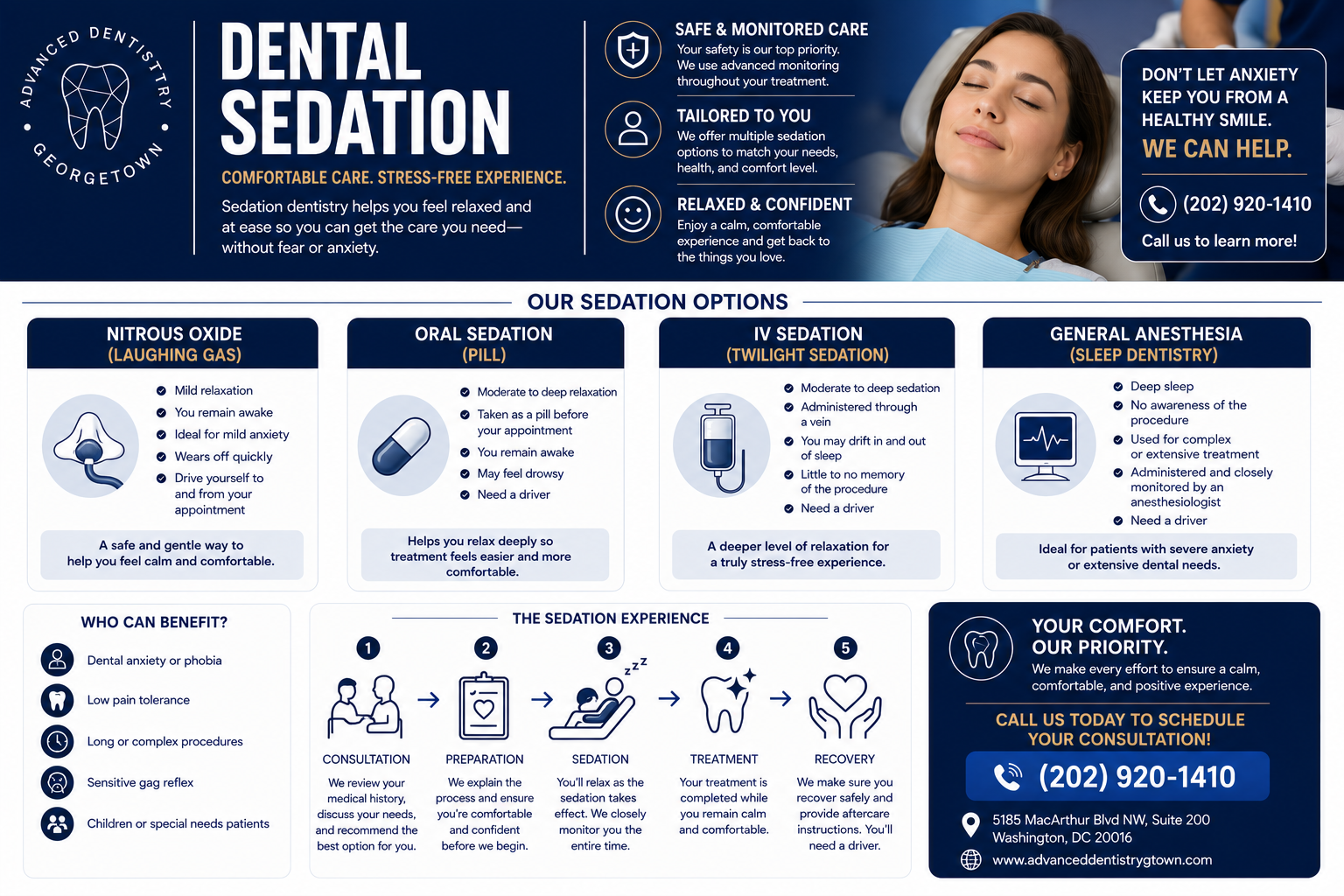
At Georgetown Advanced Dentistry, Dr. Sinclair Davis, DDS, offers multiple sedation options ranging from gentle nitrous oxide for mild nervousness to deeper sedation for extensive procedures or severe dental phobia. Every method is administered with continuous monitoring of vital signs by trained staff. Whether you have a low pain tolerance, a sensitive gag reflex, longstanding dental anxiety, or you're planning multiple procedures in a single visit, we can build a comfort plan that fits. We serve patients throughout Washington, DC, including Georgetown, Palisades, Chevy Chase, Tenleytown, and Northwest DC.
Matching Sedation to Your Comfort Level
The right sedation option depends on your anxiety level, the procedure planned, and your medical history. Here's a general guide — Dr. Davis will make a personalized recommendation during your consultation.
Nervous but Manageable
You feel some anxiety but can generally sit through routine care. You'd like something to take the edge off during a filling, cleaning, or minor procedure.
Anxious & Avoiding Care
Your anxiety has caused you to postpone or avoid dental visits. You want to be more deeply relaxed — maybe drift off — and remember less of the appointment.
Phobia or Long Procedures
You have significant dental phobia, a strong gag reflex, or need multiple complex procedures completed in one visit — where deeper sedation makes the treatment possible.
Continuous Monitoring, Trained Team
Sedation dentistry is remarkably safe when administered by properly trained professionals with the right monitoring in place. Every sedation visit at Georgetown Advanced Dentistry follows the same protocols developed for maximum patient safety.
- Thorough medical history review before every sedation
- Continuous monitoring of heart rate and blood pressure
- Continuous pulse oximetry (oxygen saturation)
- Trained staff present throughout the visit
- Titrated dosing — adjusted in real time to your comfort
- Post-sedation recovery and monitoring before discharge
- Clear pre-appointment and aftercare instructions
- Emergency protocols in place for every visit
Managing Dental Anxiety at Every Visit
Sedation is one tool — not the only one. These small adjustments help patients feel more in control from the moment they walk in.
Open Communication
Share your specific fears with the team when booking. We adjust the pace, explanations, and approach to what works best for you.
An Agreed Stop Signal
Raise a hand or use a physical cue at any point to pause the appointment. That control alone reduces anxiety significantly.
Bring Distractions
Headphones with music or a podcast block the sound of dental equipment. A stress ball or fidget item during the visit is welcome.
Frequently Asked Questions
Straight answers to what patients ask most about dental sedation.
Will I be asleep during sedation dentistry?
It depends on the level. With nitrous oxide, oral sedation, and IV sedation, you remain conscious and responsive — deeply relaxed, but not asleep. You may drift into a light nap during oral or IV sedation, but you'll respond to verbal cues from the team. Only general anesthesia renders you fully unconscious, and it's reserved for extensive surgeries or severe dental phobia cases.
What is the safest sedation for dental work?
Local anesthesia combined with nitrous oxide is widely considered the safest option for the widest range of patients. It provides mild, controllable relaxation, wears off almost immediately after the mask is removed, and lets you drive yourself home. That said, deeper sedation is also very safe when administered by properly trained professionals with continuous monitoring in place — which is standard at Georgetown Advanced Dentistry for every sedation visit.
How long does dental sedation last?
It varies by method. Nitrous oxide wears off within 5 to 10 minutes after the mask is removed. Oral sedation typically produces grogginess for 2 to 6 hours, with mild residual effects lasting up to 12 hours. IV sedation's primary effects last 4 to 8 hours, with full clearance taking up to 24 hours. General anesthesia takes the longest — expect 12 to 24 hours before you feel fully yourself. For anything beyond nitrous oxide, plan for a companion to drive you home and stay with you for the day.
Does insurance cover sedation dentistry?
Coverage varies significantly by plan. Most dental insurance treats sedation as an elective add-on and does not cover it — particularly for anxiety-related use. Some plans do provide partial coverage when sedation is deemed medically necessary due to complex surgical needs, physical trauma, or specific medical conditions. Our team can help you understand your specific plan's coverage before treatment. Sedation adds a supplemental fee that varies by method; for precise pricing, a consultation and evaluation are the best starting point.
Will I feel any pain with dental sedation?
No — sedation dentistry significantly reduces anxiety and dulls your perception of discomfort, and it's essentially always combined with local anesthesia to completely numb the treatment area. Local anesthesia is what prevents pain during the procedure itself; sedation is what keeps you calm and comfortable. Together, they make even lengthy or complex treatments feel like a much shorter, easier visit.
Can I eat before sedation dentistry?
Instructions depend on the type of sedation planned. For nitrous oxide, a light meal beforehand is generally fine. For oral sedation, IV sedation, or general anesthesia, you'll typically be asked to fast for a period beforehand (usually 6 to 8 hours for solids). We provide specific written instructions in advance of every sedation appointment — following them carefully is important for your safety.
Schedule a Sedation Consultation in Washington, DC
If dental anxiety has been keeping you from care you need, let's talk about how sedation dentistry can help. Contact Georgetown Advanced Dentistry to schedule a no-pressure consultation with Dr. Davis.