Wisdom Teeth Removal in Washington, DC
Advanced extractions performed in-house by a Johns Hopkins-trained oral surgeon
Please don't hesitate to call us at (202) 920-1410
Most family dentists refer wisdom teeth cases out to oral surgeons. At Georgetown Advanced Dentistry, Dr. Sinclair Davis handles them in-house — using the same training and techniques used at the specialty level, right here in one familiar office.
Dr. Davis's Johns Hopkins Oral Surgery Fellowship means you don't have to be shuttled between offices, coordinate care with a stranger, or wait weeks for a specialist consultation. From routine erupted extractions to complex full bony impactions, wisdom teeth removal is performed with precision, comfort-focused sedation options, and thorough aftercare — all within the practice you already know. We serve patients throughout Washington, DC, including Georgetown, Palisades, Chevy Chase, Tenleytown, and Northwest DC.
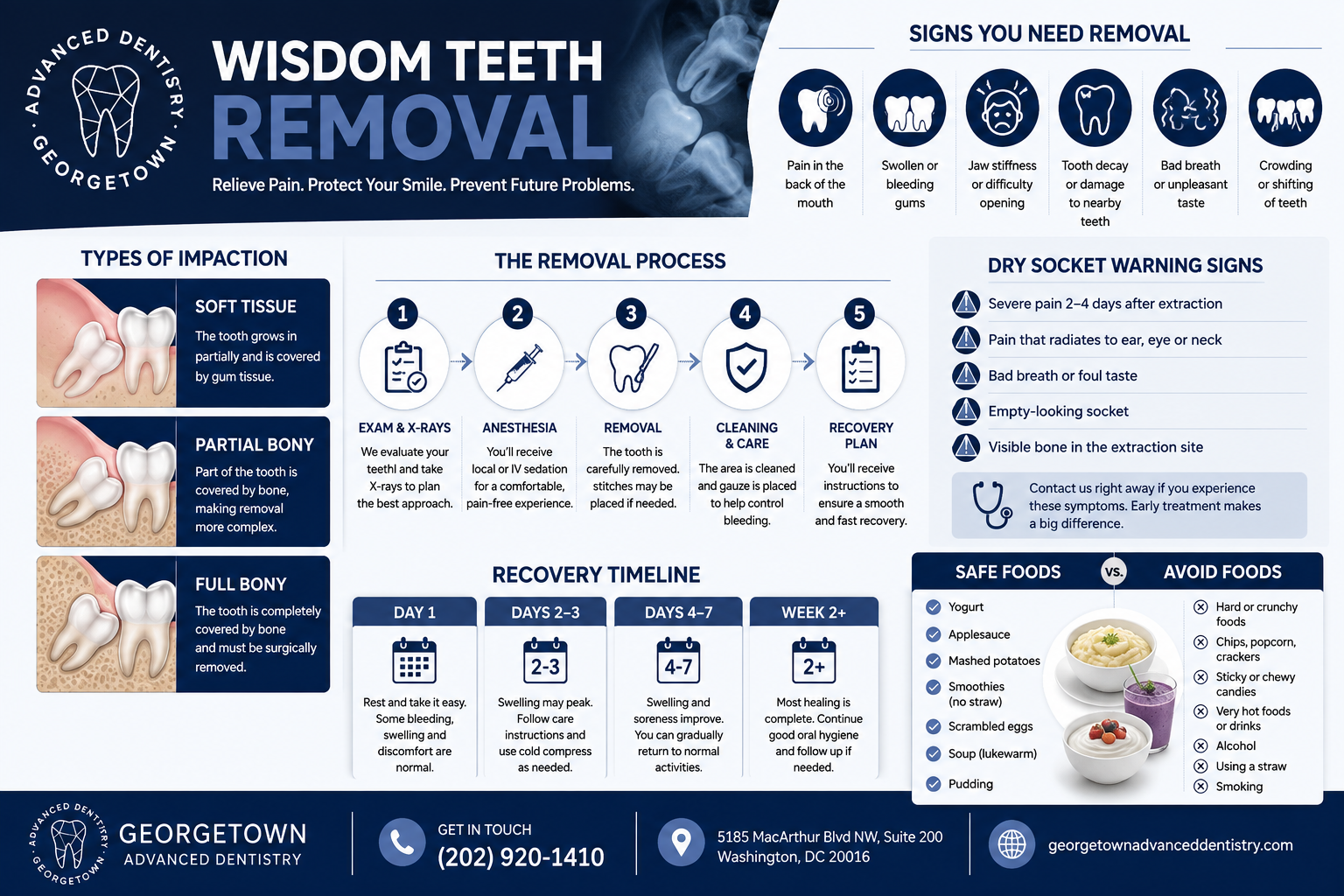
Common Signs Wisdom Teeth Need to Come Out
Wisdom teeth cause problems in the majority of adults. Watch for these warning signs — they're your body's signal to schedule an evaluation.
Pain in the Back of the Mouth
Persistent aching, throbbing, or sharp pain in the back of the jaw near the molars — often the first sign wisdom teeth are trying to erupt.
Swollen or Bleeding Gums
Red, tender, or bleeding gums around the back molars, sometimes with a partial gum flap over the erupting tooth.
Jaw Stiffness or Difficulty Opening
Trouble opening your mouth fully, or discomfort when chewing near the back of your jaw.
Decay or Damage to Nearby Teeth
Wisdom teeth are hard to clean and often develop decay — or push against neighboring molars, causing damage to those roots.
Bad Breath or Unpleasant Taste
A lingering bad taste or persistent odor from food and bacteria trapped under gum flaps of partially erupted wisdom teeth.
Crowding or Shifting Teeth
Front teeth beginning to overlap, twist, or crowd together due to pressure from wisdom teeth pushing forward from the back.
Three Levels of Wisdom Tooth Impaction
Not every wisdom tooth is straightforward. The level of impaction determines how complex the extraction will be — and why oral surgery training matters.
Soft Tissue Impaction
The tooth has partially broken through the gum but remains partly covered by soft gum tissue. Often traps food and bacteria, causing gum inflammation. Generally the most straightforward to remove.
Partial Bony Impaction
Part of the tooth is covered by bone, with some of it still under gum tissue. Removal requires cutting through gum tissue and may involve removing some overlying bone — more complex than a soft tissue impaction.
Full Bony Impaction
The tooth is completely covered by bone and must be surgically removed. The most complex extraction — this is where oral surgery training and advanced technique make the biggest difference in outcomes and comfort.
What Happens During Your Procedure
Every wisdom tooth extraction follows a consistent, comfort-focused process — with anesthesia and sedation matched to your case.
Exam & X-Rays
We evaluate your teeth and take detailed X-rays to plan the best surgical approach.
Anesthesia
Local anesthesia numbs the area, with sedation options for a comfortable, pain-free experience.
Removal
The tooth is carefully removed. Sutures may be placed if a gum incision was needed.
Cleaning & Care
The area is thoroughly cleaned and gauze is placed to control bleeding and start clot formation.
Recovery Plan
You leave with clear aftercare instructions to ensure smooth and fast recovery.
What to Expect Day by Day
Most patients recover fully within 1–2 weeks. Here's what a typical recovery looks like.
The First 24 Hours
Rest and take it easy. Blood clots form over the sockets — protect them by biting on gauze, applying ice packs, and avoiding straws, spitting, and smoking. Some bleeding and initial numbness from anesthesia are normal.
Peak Swelling & Discomfort
Facial swelling and jaw stiffness typically reach their highest point. Stick to soft, cool foods. Take pain medication on schedule. Bruising may appear — all normal. Gentle warm salt water rinses can begin carefully after 24 hours.
Gradual Improvement
Swelling and pain drop significantly. Most patients return to work or light activities by day four. Sutures begin to dissolve. You can slowly reintroduce semi-soft foods like eggs, pasta, or oatmeal.
Return to Normal
Gums continue to close over the extraction sites. Most soreness and bruising fade. You can gradually return to your normal diet (chewing away from the surgical sites) and resume regular exercise.
Watch For These Signs of Dry Socket
Dry socket happens when the protective blood clot dislodges or fails to form 2–4 days after extraction, leaving bone and nerves exposed. It's uncommon but painful — and treatable when caught early. Call us immediately if you notice any of these signs:
- Severe throbbing pain 2–4 days after extraction
- Pain that radiates to your ear, eye, or neck
- Bad breath or a persistent foul taste
- An empty-looking socket where you can see bone
- Pain that gets worse instead of improving
- Standard pain medications aren't helping
Foods to Enjoy — and Foods to Skip
The right foods speed healing. The wrong foods risk dislodging blood clots or getting trapped in extraction sites.
Safe Foods
- Yogurt (plain or with mixed-in flavor)
- Applesauce and pureed fruits
- Mashed potatoes (cool, not hot)
- Smoothies (eaten with a spoon — no straws)
- Scrambled eggs (well-cooked, soft)
- Lukewarm broth-based soups
- Pudding, ice cream, gelatin
- Cottage cheese and soft cheeses
Foods & Habits to Avoid
- Hard or crunchy foods (chips, nuts, popcorn)
- Chewy or sticky candies
- Very hot foods or drinks
- Sesame seeds, rice, quinoa — can trap in sockets
- Spicy or acidic foods (burn raw tissue)
- Alcohol during recovery
- Straws (suction dislodges blood clots)
- Smoking and vaping

Oral Surgery Training, No Referral Needed
Most family dentists refer wisdom teeth cases out to a separate oral surgery practice — meaning a new office, a new team, new intake forms, and coordination between offices. Dr. Davis's Johns Hopkins Oral Surgery Fellowship means you get specialist-level care from a familiar clinician, in a familiar office, with the same team you already trust for your general extractions and other dental care.
Frequently Asked Questions
Straight answers to what patients ask most about wisdom teeth removal.
How painful is wisdom tooth extraction?
The procedure itself is not painful — the surgical area is thoroughly numbed with local anesthesia, and sedation options are available to keep you comfortable, relaxed, or fully asleep. You may feel slight pressure or pushing during the extraction, but not sharp pain. After the anesthesia wears off, mild to moderate soreness and swelling are normal for the first few days and easily managed with prescribed or over-the-counter pain relievers.
How long is recovery after removing wisdom teeth?
Most patients return to normal daily activities within 3 to 5 days, though full healing of gum tissue and extraction sites takes approximately 1 to 2 weeks. Swelling typically peaks around days 2 to 3 and improves noticeably by day 4. Complete internal bone healing continues for several weeks to months afterward. Following your aftercare instructions closely — avoiding straws, smoking, and vigorous rinsing — is the biggest factor in a smooth recovery.
What is the best age to remove wisdom teeth?
The ideal window is generally between ages 17 and 25. During this range, the tooth roots are only two-thirds formed, the surrounding jawbone is less dense, and the body heals faster — all of which significantly reduce surgical complexity and recovery time. That said, wisdom teeth can be safely removed at any age when clinically necessary. Adults in their 30s, 40s, and beyond routinely undergo the procedure successfully; it's just typically more complex and takes slightly longer to heal.
Do I always need to have my wisdom teeth removed?
No — not everyone needs their wisdom teeth removed. If they are fully erupted into a proper vertical position, healthy, free of decay or gum disease, easy to clean with regular brushing and flossing, and not causing crowding or damage to neighboring teeth, they can be left alone and monitored. Dental experts today only recommend extraction when there's a clear clinical reason. A diagnostic evaluation with X-rays is the only way to know for sure.
How do I prevent dry socket after wisdom teeth removal?
Protecting the blood clot that forms in the extraction site is the key to preventing dry socket. For at least the first 3 to 7 days, strictly avoid: drinking through straws, forceful spitting, vigorous rinsing, smoking or vaping, and alcohol. Follow the aftercare instructions carefully, take medications as prescribed, and eat only soft foods during the initial recovery period. If severe throbbing pain develops 2 to 4 days after your extraction, contact us immediately.
Can I get sedation for wisdom teeth removal?
Yes — sedation is widely available and commonly used. Options range from nitrous oxide (laughing gas) for mild relaxation, to oral sedation pills for deeper drowsiness, to IV sedation for a twilight-sleep experience where you remember little to nothing of the procedure. Dr. Davis will recommend the level of sedation best matched to your anxiety level, medical history, and the complexity of your extraction. Learn more about our sedation dentistry options.
Schedule a Wisdom Teeth Consultation in Washington, DC
If your wisdom teeth are causing pain, pressure, or you're just due for an evaluation, Dr. Davis can assess your case with 3D imaging and walk through your options. No referral needed — everything happens under one roof.