
TMJ & Jaw Pain Treatment in Washington, DC
Relief from jaw pain, clicking, and grinding — with a plan built around the root cause, not just the symptoms
Please don't hesitate to call us at (202) 920-1410
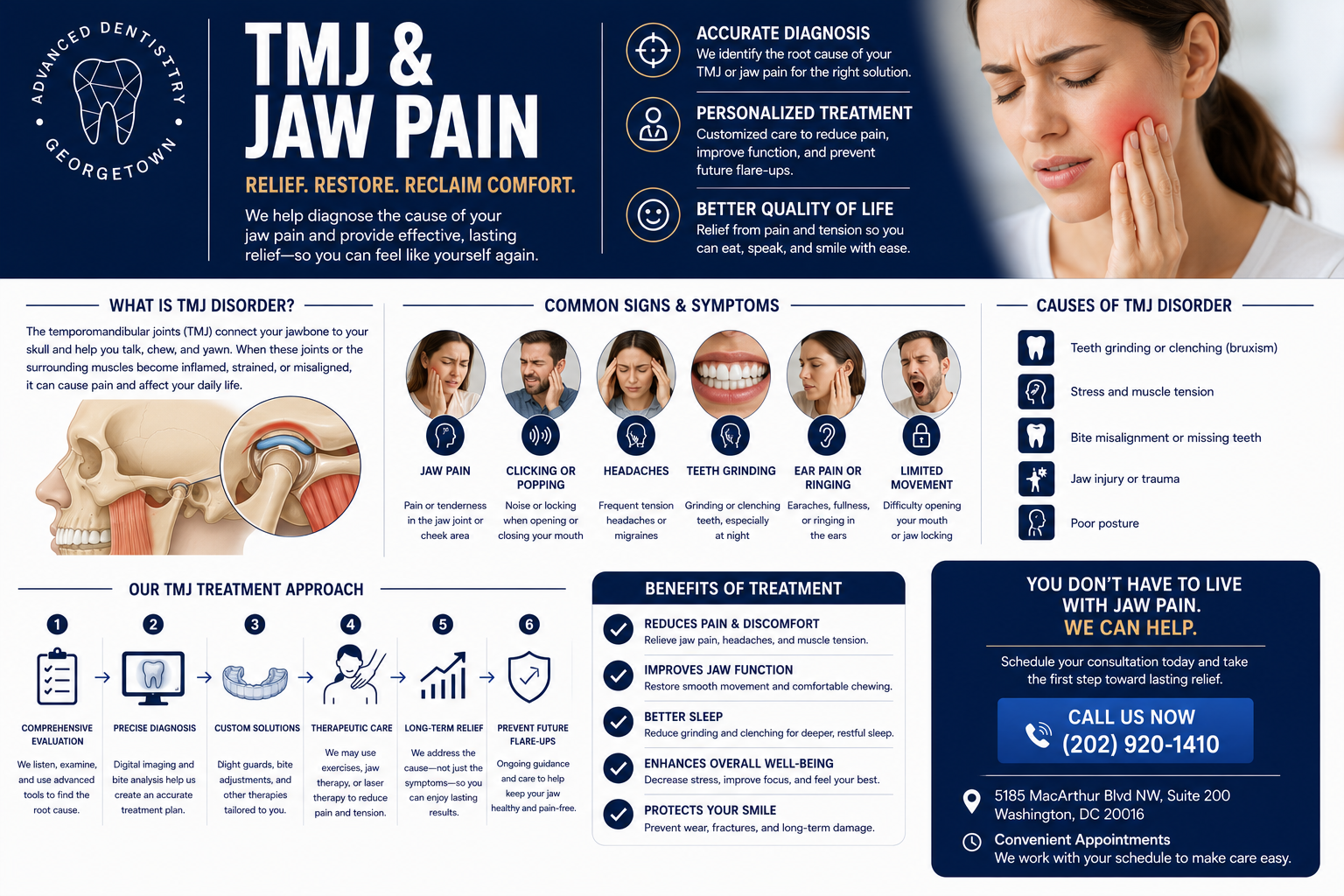
Jaw pain, morning headaches, clicking when you open your mouth, or a jaw that occasionally locks — these are the everyday signs of temporomandibular joint (TMJ) dysfunction that too many people simply learn to live with.
They don't have to. TMJ is one of the most treatable causes of chronic head, neck, and jaw discomfort — but effective treatment requires identifying the specific cause driving it. At Georgetown Advanced Dentistry, Dr. Sinclair Davis, DDS, evaluates TMJ and jaw pain diagnostically — bite alignment, muscle tension patterns, joint function, and grinding history — and builds a treatment plan around what's actually driving your symptoms. We serve TMJ patients throughout Washington, DC, including Georgetown, Palisades, Chevy Chase, Tenleytown, and Northwest DC.
How TMJ Shows Up
TMJ symptoms group into three clusters. Most patients recognize signs from more than one — that overlap is part of what makes accurate diagnosis important.
Pain & Discomfort
- Jaw pain or tenderness in the jawline, cheek, or face
- Difficulty or pain when chewing food
- Earaches or a sensation of fullness in the ears
- Neck and shoulder tension or aches
- Tenderness when pressing along the jaw muscles
Joint Sounds & Movement
- Clicking or popping when opening or closing the mouth
- Grinding sensations inside the joint itself
- Jaw locking — briefly stuck open or closed
- Limited range of motion when yawning or speaking
- Deviation of the jaw to one side when opening
Head & Face Signs
- Headaches, often concentrated around the temples
- Tinnitus (ringing in the ears) or dizziness
- Changes in how upper and lower teeth fit together
- Facial tightness or stiffness in the morning
- Flattened, chipped, or worn-down teeth
The 3-Finger Test for TMJ
Vertically stack your index, middle, and ring fingers and try to fit all three between your upper and lower front teeth. If you can comfortably fit three fingers, your jaw mobility is generally within normal range.
If you cannot fit three fingers — or if the attempt causes pain, clicking, or jaw discomfort — that's an early indicator of restricted mobility or TMJ dysfunction. A professional evaluation can identify the underlying cause.
What Actually Triggers TMJ
TMJ is rarely caused by one thing alone. Effective treatment depends on identifying which of these factors is driving your case.
Teeth Grinding (Bruxism)
Nighttime clenching or grinding places heavy, repeated stress on the jaw joint and muscles.
Stress & Muscle Tension
Chronic stress leads to daytime clenching and tightening of the facial muscles that support the jaw.
Bite Misalignment
Teeth that don't come together evenly force the jaw to strain in order to close properly.
Disc Displacement
The small cushioning disc inside the joint slips out of alignment, causing clicking and locking.
Jaw Trauma or Injury
A past impact injury, whiplash, or fall can leave the joint structurally compromised over time.
Arthritis in the Joint
Osteoarthritis or rheumatoid arthritis can affect the temporomandibular joint like any other joint.
TMJ Headache or Migraine?
The two often overlap and can trigger each other — but they respond to different treatments. Understanding which one you have shapes the entire care plan.
TMJ-Related Headache
Musculoskeletal Origin
Migraine
Neurological Origin
Important: The two conditions frequently coexist and share the trigeminal nerve pathway. Overworked jaw muscles can trigger migraines in patients who are already prone to them. If you experience both, treating the TMJ often reduces migraine frequency.
Escalating Treatment Approach
TMJ treatment starts with the most conservative options that address your specific case and moves to more intensive interventions only if needed.
Lifestyle & Habit Adjustments
Soft-food diet during flare-ups, avoiding wide yawns and gum chewing, stress management, and gentle jaw exercises. For many patients with mild-to-moderate symptoms, this level of intervention combined with awareness of daytime clenching resolves the problem.
Custom Night Guard
A precision-fit acrylic guard worn during sleep — cushions the jaw joint, prevents grinding damage to the teeth, and relaxes the surrounding musculature. Custom night guards from Georgetown Advanced Dentistry are individually fabricated and significantly more effective than over-the-counter alternatives.
Occlusal Adjustment or Alignment
When bite misalignment is the underlying driver, correcting the occlusion — through selective reshaping, restoration, or Invisalign orthodontic treatment — can resolve the mechanical strain producing the TMJ symptoms.
Botox for TMJ & Bruxism
Therapeutic Botox injections into the masseter and temporalis muscles relax involuntary clenching and grinding — effective for severe cases where lifestyle changes and night guards aren't sufficient. Results typically last 3 to 4 months. Considered when other options have plateaued.
Repairing Grinding Damage
Years of bruxism often leave teeth flattened, chipped, or cracked. Once the underlying grinding is controlled, restoration with custom crowns or veneers rebuilds the damaged tooth structure and restores proper bite function.
TMJ Exercises You Can Do at Home
Gentle exercises that support professional treatment. Never force these movements — stop immediately if you feel sharp pain.
Goldfish Exercise
Place your tongue on the roof of your mouth. Put one index finger on your TMJ joint (in front of your ear) and the other under your chin. Open your mouth halfway, hold for 2 seconds, and close.
Chin Tucks
Sit or stand with shoulders back. Pull your head and chin straight back to create a double chin. Hold for 3 to 5 seconds. This helps posture-related jaw strain.
Resisted Opening
Place your thumb gently under your chin. Open your mouth slowly while pushing up lightly with your thumb to create mild resistance. Hold for 1 second, then relax.
Relaxed Jaw Rest
Keep your teeth slightly apart and rest the tip of your tongue gently on the roof of your mouth behind your front teeth. Breathe slowly through your nose.
Frequently Asked Questions
Straight answers to the questions patients ask most about TMJ and jaw pain.
What is the 3-finger test for TMJ?
The 3-finger test is a quick self-screening for jaw mobility: you should comfortably be able to vertically stack your index, middle, and ring fingers between your upper and lower front teeth. An inability to fit three fingers — or pain when attempting to — is a common early indicator of restricted jaw opening or TMJ dysfunction. It's a useful screening tool but not a diagnostic replacement for a professional evaluation.
Will my TMJ go away on its own?
Sometimes, yes. Mild TMJ triggered by acute stress, temporary muscle tension, or a specific short-term event can resolve on its own with time and self-care. However, TMJ driven by chronic bruxism, bite misalignment, or structural joint issues typically will not resolve without intervention — and the damage to teeth and joint tissue accumulates over time. If symptoms have persisted for more than a few weeks, a professional evaluation is the right step.
Do night guards actually help TMJ?
Yes — custom-fitted night guards are one of the most effective conservative treatments for TMJ. They cushion the jaw joint, reduce muscle tension during sleep, and protect the teeth from grinding damage. The key qualifier is custom-fitted. Over-the-counter boil-and-bite guards often fit poorly and can occasionally worsen the underlying problem. A custom guard made from a precise impression of your teeth is a meaningfully different device.
Does Botox for TMJ really work?
For appropriate cases, yes. Therapeutic Botox injections into the masseter and temporalis muscles reduce involuntary clenching and grinding by relaxing those muscles for approximately 3 to 4 months. It's most useful for severe bruxism cases where night guards and lifestyle changes have not been sufficient. It's a management tool rather than a permanent cure — the underlying condition remains, but the muscle-driven symptoms are significantly reduced.
Can TMJ cause ear pain or ringing?
Yes. The temporomandibular joint sits directly in front of the ear, and TMJ dysfunction can produce sensations of ear fullness, earache, or tinnitus (ringing in the ears). Patients sometimes see multiple ENT specialists before the ear symptoms are traced back to their jaw. If your ear discomfort worsens when chewing or is accompanied by jaw clicking, TMJ is a likely candidate.
Is TMJ pain worse in the morning?
Very commonly, yes — because nighttime bruxism (clenching or grinding during sleep) is one of the primary drivers of TMJ symptoms. Patients who wake with jaw soreness, tight facial muscles, or headaches concentrated around the temples are usually grinding their teeth overnight, often without knowing it. A custom night guard is typically the first intervention for this pattern.
Schedule a TMJ Consultation in Washington, DC
If you've been living with jaw pain, morning headaches, clicking, or grinding, a proper evaluation is the first step toward lasting relief. Contact Georgetown Advanced Dentistry to schedule a consultation with Dr. Davis.