Preventive Dental Care in Washington, DC
Protect your health. Keep your smile. Catch issues early — before they become problems.
Please don't hesitate to call us at (202) 920-1410
The best dentistry is the dentistry you never need. Preventive care catches problems early, protects the health you already have, and saves you from the cost, time, and discomfort of restorative treatment down the road.
At Georgetown Advanced Dentistry, Dr. Sinclair Davis, DDS, and our team build a personalized prevention plan around your specific risk factors — combining professional cleanings, comprehensive exams, oral cancer screenings, diagnostic X-rays, and targeted treatments like fluoride and sealants when appropriate. Whether you're due for your routine six-month visit, haven't been in for a while, or just moved to the area, we make it easy to get back on track. We serve patients throughout Washington, DC, including Georgetown, Palisades, Chevy Chase, Tenleytown, and Northwest DC.
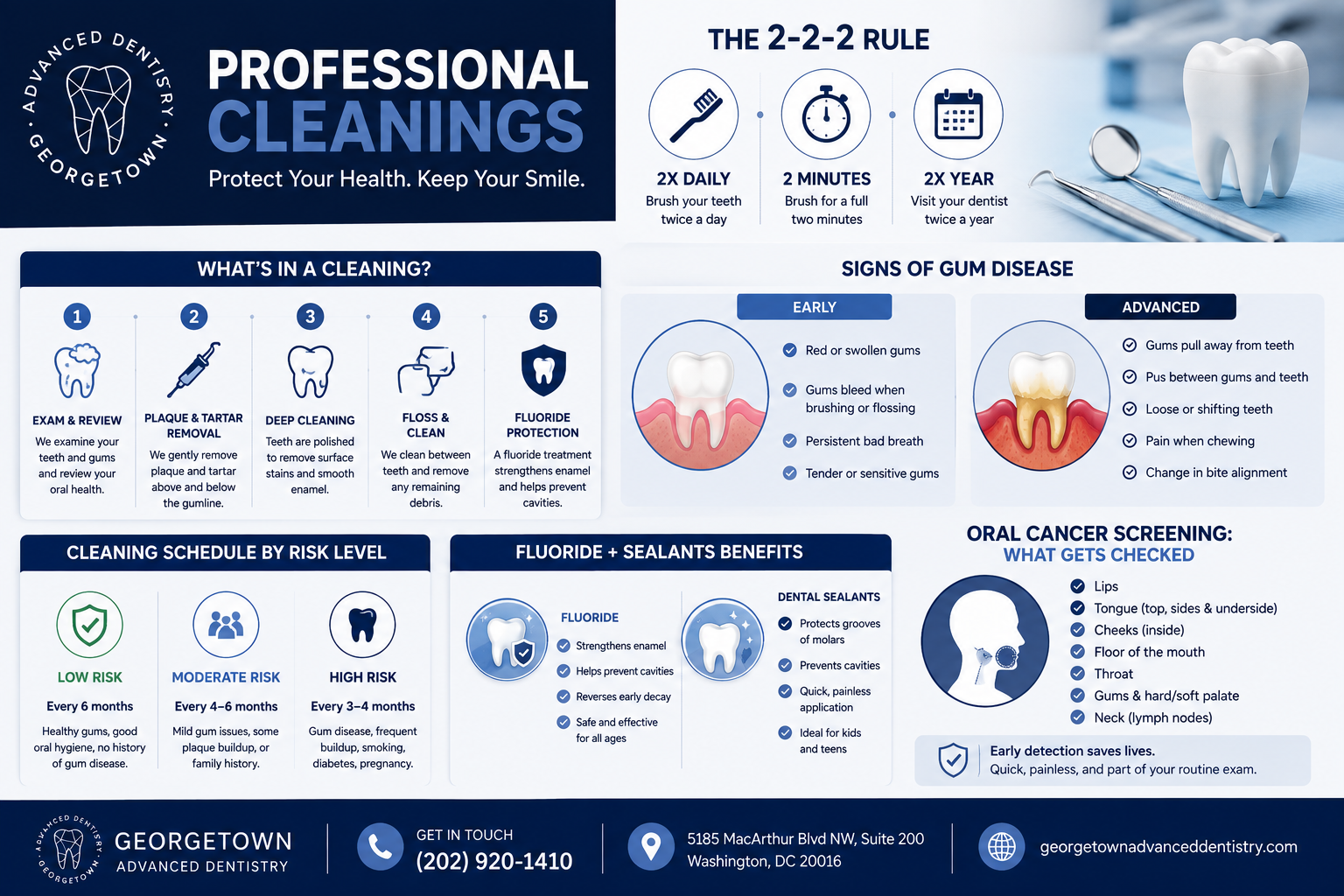
The 2-2-2 Rule for Optimal Oral Health
Simple, memorable, and clinically backed. This is the baseline every adult should aim for to protect their teeth and gums for life.
A Day
Brush your teeth thoroughly — once in the morning and once before bed. This baseline protects against the daily buildup of plaque and food debris.
Minutes Each Time
Spend a full two minutes brushing — most people rush through in 30–45 seconds. Two minutes ensures every surface is properly cleaned.
A Year at the Dentist
Visit your dentist every six months for a professional cleaning and comprehensive exam — the two most effective preventive treatments in dentistry.
The Five Steps of a Professional Cleaning
A thorough cleaning takes 30 to 60 minutes and follows a consistent, evidence-based process.
Exam & Review
We examine your teeth and gums and review your oral health history before beginning.
Plaque & Tartar Removal
We gently remove plaque and hardened tartar from above and below the gum line.
Deep Cleaning
Teeth are polished to remove surface stains and smooth the enamel.
Floss & Clean
Professional flossing removes debris between teeth and clears any remaining polish.
Fluoride Protection
A fluoride treatment strengthens enamel and helps prevent future cavities.
Cleaning Frequency by Risk Level
Not everyone needs the same schedule. Dr. Davis assesses your specific risk factors and recommends the frequency that keeps you at your healthiest.
Standard Care
Healthy gums, good oral hygiene, no history of gum disease. The gold standard for most adults with strong preventive habits.
Enhanced Care
Mild gum issues, some plaque buildup, family history of dental problems, or lifestyle factors that increase risk.
Intensive Care
Active or history of gum disease, frequent buildup, smoking, diabetes, pregnancy, or weakened immune system.
Signs of Gum Disease to Watch For
Gum disease is one of the most common — and most preventable — reasons for tooth loss in adults. Early detection makes all the difference.
Early Signs (Gingivitis)
Reversible with proper care and professional cleanings
- Red or swollen gums that appear inflamed
- Gums bleed when brushing or flossing
- Persistent bad breath that won't clear
- Tender or sensitive gums when touched
- Slight puffiness along the gum line
Advanced Signs (Periodontitis)
Progression can be halted, but damage cannot be fully reversed
- Gums pulling away or receding from teeth
- Pus visible between the gums and teeth
- Loose or shifting teeth
- Pain when chewing or biting down
- Changes in how your teeth fit together
Fluoride Treatments & Dental Sealants
Beyond standard cleanings, these two treatments provide targeted protection where and when it matters most.
Fluoride Treatments
A quick, painless application of concentrated fluoride varnish, foam, or gel — remineralizes weakened enamel, reverses early-stage decay, and protects exposed root surfaces.
- Strengthens tooth enamel against acid attacks
- Helps prevent new cavities from forming
- Can reverse very early stages of decay
- Safe and effective for children and adults
- Especially beneficial for gum recession or dry mouth
Dental Sealants
Thin protective coatings painted onto the chewing surfaces of back molars — where deep grooves make cavity prevention hardest with brushing alone.
- Protects deep grooves in back molars
- Prevents cavities where brushing can't reach
- Quick, painless, no drilling required
- Ideal for children, teens, and select adults
- Can reduce decay risk by up to 80% on treated teeth
Oral Cancer Screening at Every Visit
Oral cancer screenings are quick, painless, and included as part of your regular preventive visit — but they save lives. Early detection makes treatment dramatically more effective. During every routine exam, we check the following areas:
- Lips (upper and lower)
- Tongue (top, sides, and underside)
- Inside of cheeks
- Floor of the mouth
- Throat and back of tongue
- Gums and hard/soft palate
- Neck and lymph nodes
- Any unusual sores or discoloration
Personalized Prevention — Not One-Size-Fits-All
Every mouth is different. Your risk factors, health history, home care habits, and goals all shape the right prevention plan for you. Instead of a rushed 15-minute cleaning and generic advice, our team takes time to understand what's working, what isn't, and what specific adjustments will make the biggest impact.
From there, we build a personalized plan that may include the right cleaning frequency, targeted treatments like fluoride or professional whitening, home care coaching, and coordination with other providers if you have systemic conditions like diabetes that affect oral health.
Frequently Asked Questions
Straight answers to what patients ask most about preventive dental care.
How often should I get my teeth cleaned?
The standard recommendation is a professional cleaning and exam every six months for most adults with healthy teeth and gums. However, patients with active gum disease, deep gum pockets, orthodontic treatment, rapid tartar buildup, or specific systemic conditions like diabetes may benefit from cleanings every 3 to 4 months. Dr. Davis will recommend the frequency that best matches your specific oral health profile — not a generic default schedule.
Is a dental cleaning painful?
For most people, a routine dental cleaning is not painful — you may feel some pressure, tickling vibrations from the ultrasonic scaler, and mild sensitivity in areas where gums are inflamed or gum recession has exposed root surfaces. If you have sensitivity, our team can adjust technique, apply numbing gel, or take extra time in sensitive areas. Discomfort during a routine cleaning is manageable and typically resolves within a day or two after the appointment.
What is the difference between a dental exam and a cleaning?
They serve different purposes but are usually done together. A dental exam is a diagnostic evaluation performed by the dentist — checking for cavities, gum disease, oral cancer, and any structural or bite issues. A cleaning is a preventive hygiene procedure typically performed by a dental hygienist — removing hardened tartar (calculus), polishing the teeth, and providing a fluoride treatment. Both are usually completed in a single visit every six months.
How often do I need dental X-rays?
It depends on your age, oral health status, and risk factors. Healthy adults with low cavity risk typically need routine bitewing X-rays every 18 to 36 months. Higher-risk patients (frequent cavities, dry mouth, multiple restorations) may need X-rays every 6 to 18 months. Children and teens with rapidly changing teeth often need imaging every 6 to 24 months. A comprehensive full-mouth or panoramic series is typically taken every 3 to 5 years to check overall jaw health.
Are dental sealants worth it for adults?
Sealants are most commonly recommended for children and teenagers, when their permanent molars first erupt with deep grooves and higher cavity risk. However, select adults with deep pit-and-fissure patterns on molars, high cavity risk, or specific dental history can also benefit. Sealants are quick, painless, and highly effective — reducing cavity risk on treated teeth by up to 80%. Dr. Davis can evaluate whether they'd add value for your specific situation.
Should adults get professional fluoride treatments?
Yes — adults benefit significantly from professional fluoride treatments in specific situations. High-concentration fluoride varnish or gel provides a much more potent dose than everyday toothpaste, strengthening vulnerable enamel and arresting early-stage cavities. Adults with exposed root surfaces from gum recession, chronic dry mouth (often medication-related), a history of frequent decay, or multiple crowns and bridges get the most benefit. Treatments are quick, painless, and typically applied during regular six-month cleanings.
Schedule Your Preventive Care Visit in Washington, DC
Due for a cleaning, haven't been to the dentist in a while, or new to the area? We make it easy to get back on track with a friendly, thorough preventive visit tailored to your needs.