
Emergency Dentist in Washington, DC
Same-day emergency dental care when it matters most
Dental emergencies can't wait — call (202) 920-1410
A dental emergency is not the moment to wait until Monday. Untreated pain and infection worsen quickly — and the difference between saving a tooth and losing it can be measured in hours.
At Georgetown Advanced Dentistry, Dr. Sinclair Davis, DDS, prioritizes emergency cases with same-day response during regular office hours and a dedicated weekend emergency line for urgent situations. His combined training in oral surgery, endodontics, and restorative dentistry means most dental emergencies — from a knocked-out tooth to a severe abscess to a broken crown — can be evaluated, treated, and stabilized in one visit rather than referred out. We serve emergency patients throughout Washington, DC, including Georgetown, Palisades, Chevy Chase, Tenleytown, and Northwest DC.
What Counts as a Dental Emergency?
If you're experiencing any of these situations, contact Georgetown Advanced Dentistry right away — and follow the immediate steps below while you're on your way.
Knocked-Out Tooth
An adult tooth that has been fully knocked out. Time-sensitive — the best outcomes require care within 30 to 60 minutes.
- Hold the tooth by the crown, not the root
- Rinse briefly with milk or water — do not scrub
- Gently try to reinsert into the socket
- If not possible, store in milk or in your cheek
- Never let the tooth dry out
Severe Toothache
Persistent, throbbing pain — especially pain that wakes you up at night or worsens when lying down. Often indicates infection.
- Rinse gently with warm salt water
- Take ibuprofen or acetaminophen as directed
- Apply a cold compress to the outside of the cheek
- Sleep with your head elevated on extra pillows
- Contact us as soon as possible
Cracked or Broken Tooth
A fractured tooth, especially one causing sharp pain when biting. Bacteria can enter the crack rapidly, leading to infection or further damage.
- Rinse with warm salt water
- Save any tooth fragments in milk or saline
- Cover sharp edges with dental wax or sugar-free gum
- Avoid chewing on that side
- Apply cold compress for pain and swelling
Dental Abscess or Infection
Facial swelling, pus, fever, or a pimple-like bump on the gum. Untreated infections can spread beyond the jaw and become medically serious.
- Rinse gently with warm salt water
- Cold compress to the outside of the cheek
- Contact our office right away — do not wait
- Never apply pain medication directly to gums
- If breathing or swallowing is affected, go to the ER
Lost Crown or Filling
A crown that has fallen off or a filling that has come out — leaving the tooth exposed to bacteria, decay, and temperature sensitivity.
- Save the crown or filling if you can find it
- Rinse gently with warm water
- Use temporary dental cement from a pharmacy
- Never use household glue or super glue
- Contact us within 24 to 48 hours
Facial Injury or Trauma
Any impact injury to the face, jaw, or mouth — with or without visible tooth damage. Sometimes the internal damage is worse than what shows.
- Control bleeding with clean gauze or cloth
- Apply cold compress to reduce swelling
- Save any tooth fragments in milk
- For suspected jaw fracture, go to the ER first
- Follow up with our office within 24 hours
Hospital ER or Emergency Dentist?
One of the most common questions patients ask during a dental emergency. Here's the practical difference between the two.
Hospital Emergency Room
ERs are equipped for medical emergencies — not dental treatment. Most hospital ERs do not have a dentist on staff or the specialized tools required.
- Can provide pain medication temporarily
- Can prescribe antibiotics for infection
- Cannot perform root canals or extractions
- Cannot re-implant a knocked-out tooth
- Will typically refer you to an emergency dentist
Emergency Dentist
An emergency dentist can actually diagnose, treat, and resolve the underlying dental issue in a single visit — not just manage symptoms.
- Diagnostic X-rays on-site
- Root canal therapy, extractions, restorations
- Can re-implant knocked-out teeth
- Can treat abscesses at the source
- Resolves the problem, not just the pain
When to go to the ER first: if you have uncontrolled bleeding, facial swelling that affects breathing, or a suspected broken jaw, go directly to the hospital emergency room. Follow up with our office afterward.
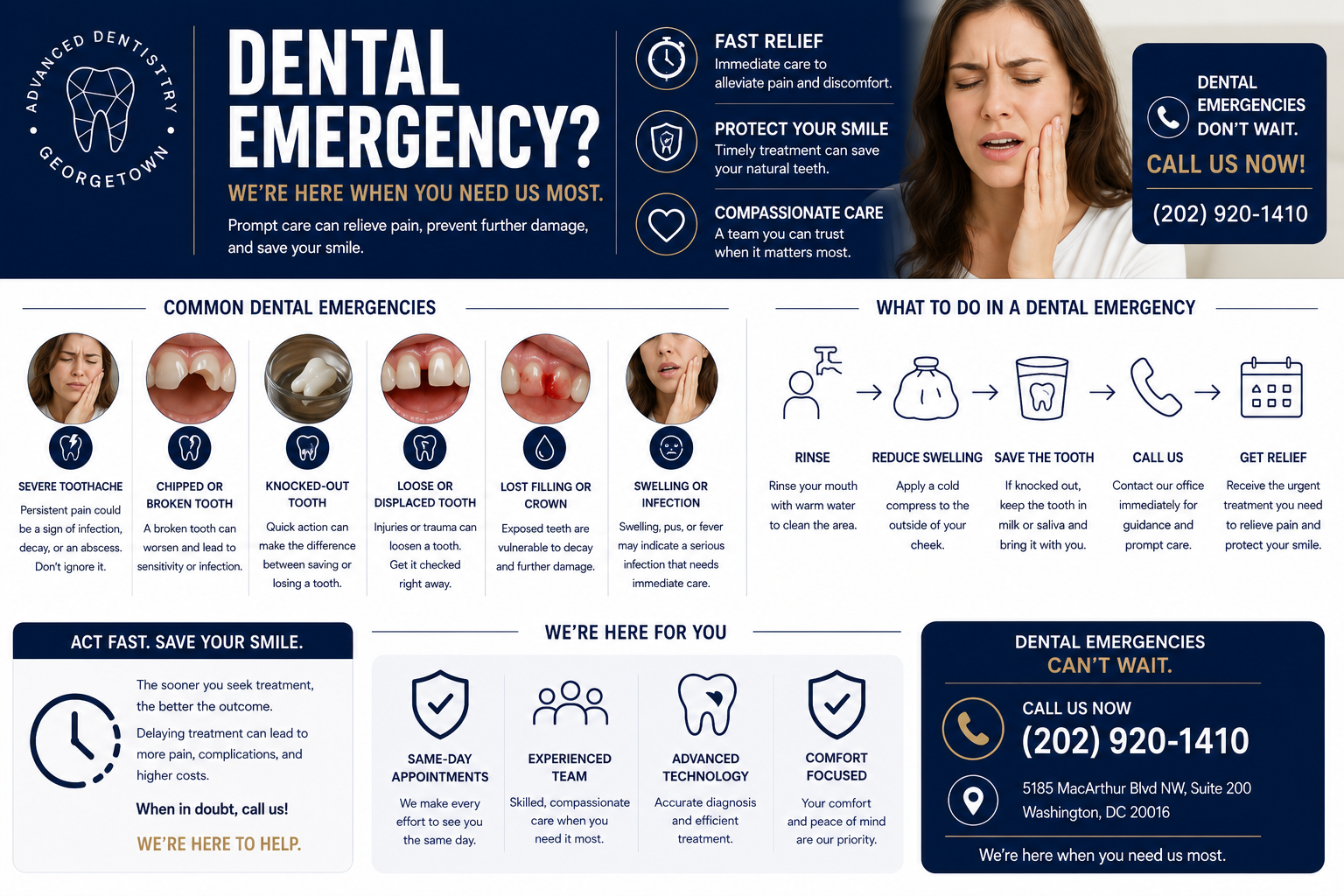
What to Do Before You Arrive
These four steps can meaningfully improve the outcome — and reduce your discomfort — before you get to the office.
Call First
Call ahead so the team can prepare for your arrival and give you specific in-transit guidance.
Manage Pain
Take ibuprofen or acetaminophen per package directions. Apply a cold compress to the outside of the cheek.
Save the Pieces
Keep any tooth fragments, knocked-out teeth, or lost crowns clean and moist — store in milk if possible.
Bring ID & Insurance
Photo ID, insurance card, and a list of current medications will speed up intake once you arrive.
Most Emergencies Handled Under One Roof
Because Dr. Davis is trained in oral surgery, endodontics, and restorative dentistry, most emergencies — a root canal for an abscessed tooth, an urgent extraction, or a temporary crown to protect a broken tooth — can be evaluated and treated in the same visit. You don't need to be referred to a specialist across town.
Call (202) 920-1410Frequently Asked Questions
Straight answers to the most common questions about dental emergencies.
Will the ER do anything for a tooth?
Hospital emergency rooms typically cannot treat the underlying dental issue because they lack dentists on staff and the specialized equipment required. They can generally only provide temporary pain relief with medication, prescribe antibiotics if an infection is present, and refer you to an emergency dentist for actual treatment. For a true dental emergency, contacting an emergency dentist directly is usually faster and more effective — unless there's uncontrolled bleeding, a suspected jaw fracture, or facial swelling that affects breathing, in which case the ER is the right first stop.
What is the 3-3-3 rule for a toothache?
The 3-3-3 rule is a common at-home guideline for managing dental pain temporarily: take over-the-counter pain relievers as directed for up to 3 days, apply cold compresses in 3 intervals, and see a dentist if pain or symptoms persist beyond 3 days. It's a way to gauge when at-home management is no longer enough and professional evaluation becomes necessary. A tooth that has been painful for more than three days should always be evaluated — the underlying cause will not resolve on its own.
Can a knocked-out tooth be saved?
Yes — a permanent tooth that has been knocked out can often be successfully replanted, especially if it reaches a dentist within 30 to 60 minutes of the injury. The critical steps are handling the tooth by the crown only (not the root), keeping it moist (in milk, saliva, or the patient's own cheek), and getting to an emergency dentist as quickly as possible. Dr. Davis can typically re-implant, splint, and stabilize the tooth in the same visit — with root canal therapy usually needed later on. Never attempt to re-implant a baby (primary) tooth.
Can an emergency dentist perform a root canal or extraction on the same day?
Yes, in most cases. Emergency root canal therapy is one of the most common same-day treatments, since it directly relieves the severe pain of an infected pulp. Same-day extractions are also routinely performed when a tooth is too damaged or infected to save. In cases of severe active infection with significant swelling, antibiotics may be prescribed first to reduce the infection before performing the procedure a few days later.
What should I do if my tooth pain is unbearable at night?
Tooth pain often worsens at night because lying flat increases blood flow and pressure around the affected nerve. Elevate your head with extra pillows, take an over-the-counter anti-inflammatory like ibuprofen, apply a cold compress to your cheek, and rinse gently with warm salt water. These measures manage the pain temporarily — they do not resolve the underlying issue. Contact our office as soon as we open in the morning. If pain is accompanied by fever, difficulty breathing, or facial swelling, that indicates a serious infection and requires emergency care immediately.
How long can I wait to see a dentist for a broken tooth?
You should not wait more than a day or two. Even if the initial pain has subsided, a broken tooth exposes the inner structure to bacteria that can rapidly cause decay, infection, or nerve damage. What starts as a fixable fracture can progress to needing a root canal or extraction within weeks if left untreated. Contact Georgetown Advanced Dentistry as soon as possible for evaluation.
Experiencing a Dental Emergency?
Don't wait — the sooner we can evaluate your situation, the better the outcome. Call Georgetown Advanced Dentistry now to speak with our team, or request an appointment online.